





















From Rushing Water to Striking Stone: Magelang Workshop Creates Art
UGM’s Community Service Program with Sanggar Gadoeng Mlati presented “Sound Space,” an integrative arts performance in Magelang that transformed river soundscapes—chiseling stone, cutting bamboo, spla


MAGELANG - Imagine an arts performance with no building for a stage, no spotlights, and no sound system. There is only a river flowing and babbling, stones struck against one another, bamboo sliced with a blade, and the hands of artists working their chisels at the water's edge. This was the scene that unfolded throughout the day on Thursday, 15 May 2026, when 30 workshop participants from Sanggar Gadoeng Mlati staged a performance and soundscape recording session along the river that runs near their arts community in Magelang, Central Java.
This was no coincidence. It was the culmination of a two-day integrative arts mentorship program organized by the Community Service team (PKM) of Universitas Gadjah Mada (UGM), under the scheme of Community Development Based on Applied Research and Community Empowerment with International Collaborators, Fiscal Year 2026. The program title says it all “From Local Sound to Global Stage: Integrative Arts Mentorship for the Gadoeng Mlati Arts Community“.
From Morning to Dusk: A Day of Sound Exploration by the River
The second day's activities ran from morning until late afternoon, transforming the river into both an expressive space and a living acoustic laboratory. The 30 participants who had attended an intensive workshop at the sanggar the day before were taken directly to the riverbank to do something modern humans rarely do: truly listen.
Not passive listening, but active capturing, discerning, and processing defined their approach to sound. Every sound within the surrounding environment was treated as raw material for artistic creation. The rushing and babbling river became the foundational tone, the keynote sound upon which the entire day’s acoustic composition was built. The striking of stone against stone produced percussive tones that shifted according to the size and type of stone, closely reflecting the daily working life of Pak Ismanto as a sculptor. Likewise, the sound of chiseling stone, the sharp resonance created when carving tools met the stone surface, formed a rhythm of labor that had long been dismissed as mere “background noise,” yet here was elevated into a significant musical element. The process of cutting bamboo also generated a rich range of acoustic textures, from the scraping sound of a saw to the sudden crack of bamboo splitting apart. Complementing these sounds were the organic acoustics of the river environment itself, birdsong, rustling leaves, and footsteps across river stones, all of which formed the most natural layer within the overall composition.
All of this sonic exploration was systematically recorded, making the second day not merely a performance but simultaneously an acoustic archive a documentation of Magelang's sound identity that had never before been captured in artistic form.
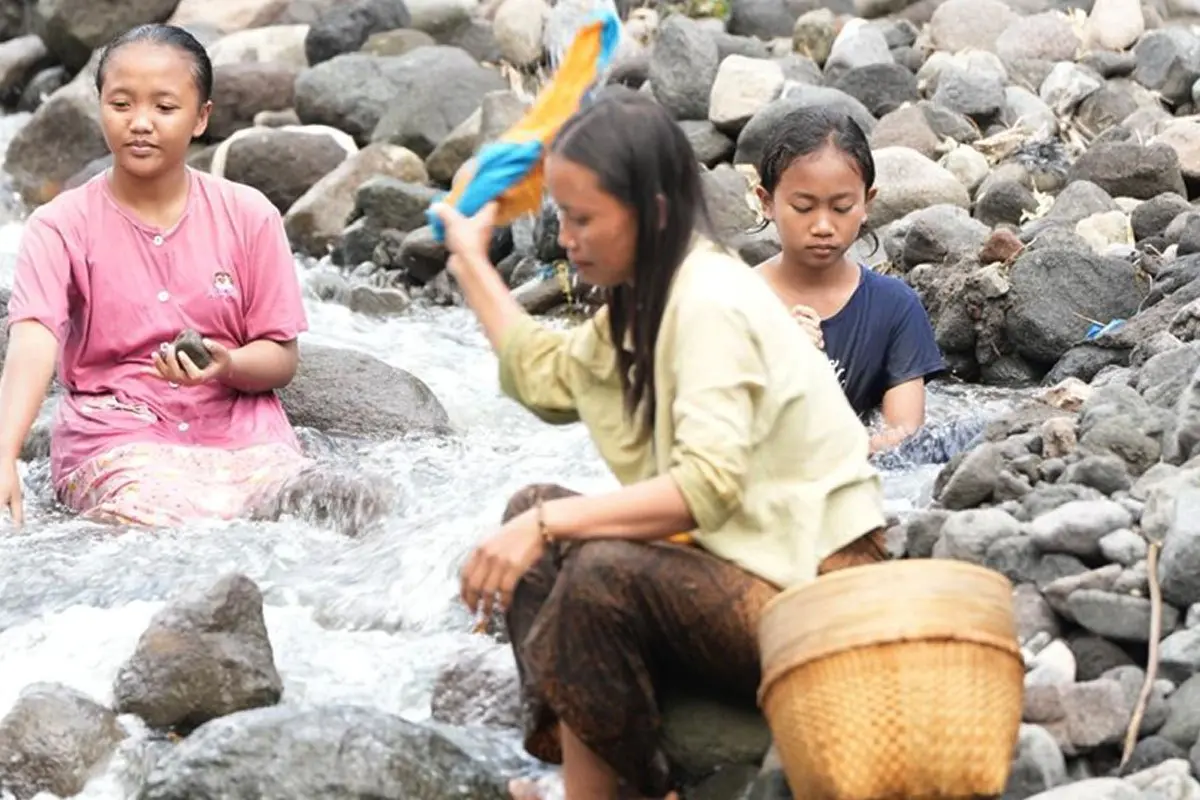 Amid the flowing river of Magelang, participants interact with water, stone, and everyday movement as part of a community based exploration of soundscape, memory, and environmental awareness l
The Performance Theme: Capturing What Has Always Been There, But Rarely Heard
The second day's performance carried the theme “Sound Space: Performance, Body, Voice, and Tradition“. This is not merely a slogan it is a firm artistic statement that tradition is not only a visual form or a verbal narrative, but also an acoustic dimension that has long been overlooked.
The sound of Pak Ismanto's chisel on stone, for example, is a sound utterly specific to Magelang one that cannot be found in the same way in any other city. In the language of soundscape studies, such a sound is called a soundmark an acoustic marker of a place that forms part of its cultural identity. And the workshop participants, having spent a full day sharpening their listening sensibility alongside three facilitators from PSPSR UGM, now channeled that awareness into performance.
The result was not a technical demonstration. What emerged was a performance born of intimacy between each artist and their own environment, with sounds that had always passed unnoticed now heard, felt, and celebrated.
Sanggar Gadoeng Mlati: When a Sculptor Conducts an Orchestra of Nature
Sanggar Gadoeng Mlati, led by Pak Ismanto, an experienced sculptor, served as the program's primary community partner. There is something deeply fitting in this arrangement: an artist whose life has been filled with sound the ring of a chisel, the scatter of stone chips, the settling of dust now leading a community to listen to all of it more deeply, and to lift it into an artistic language capable of speaking on a wider stage, in the form of soundscape.
The 30 participants in the performance were members and community figures of the sanggar, spanning multiple generations, who had attended the full workshop on the first day (14 May 2026). They are not trained musicians, not professional composers and that is precisely where this program's strength lies. When people who work daily with stone, bamboo, and river water begin to hear their working tools as instruments, something deeply authentic and irreplicable is born.
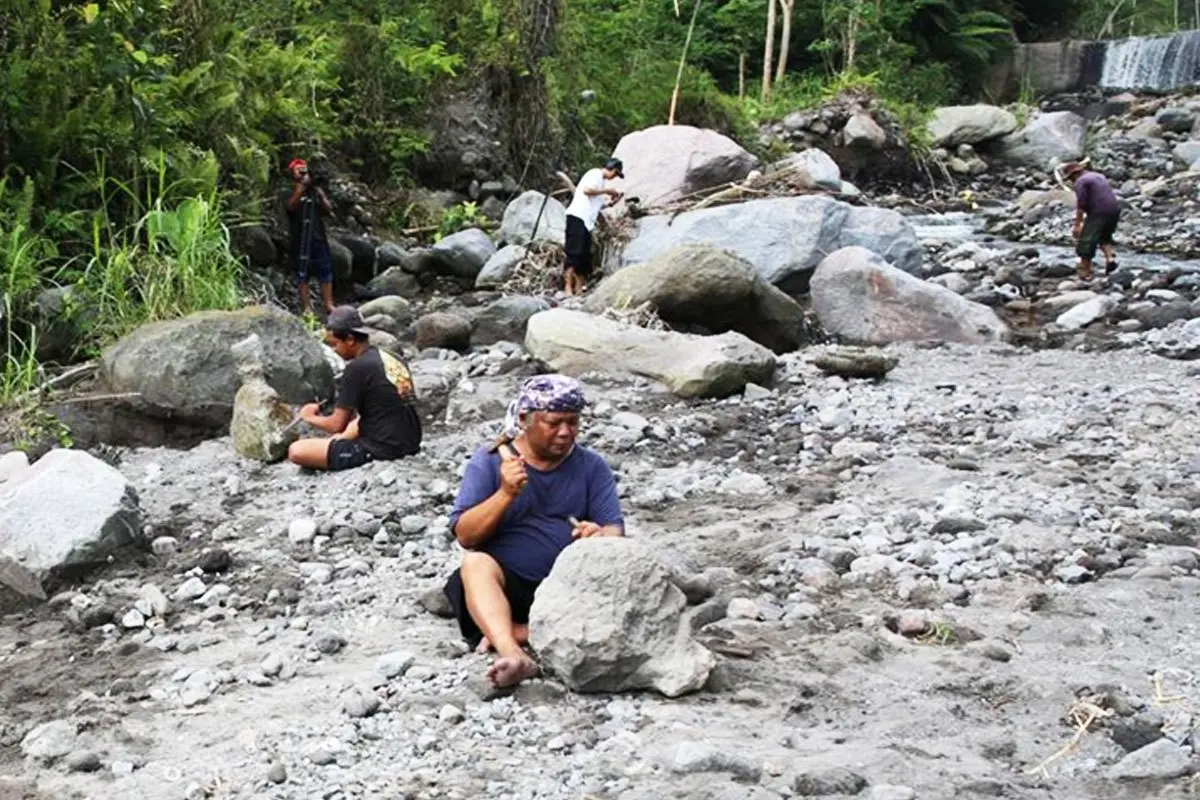 For Pak Ismanto, stone is more than material. Along the rivers flowing from Mount Merapi, each strike of the chisel carries memory, tradition, and the disappearing acoustic identity of Magelang.
The UGM Team and Facilitators: Academics Who Came Down to the River
The program was conceived and led by Dr. Rr. Paramita Dyah Fitriasari as team leader, alongside members Dr. Djarot Heru Santoso, M.Hum and Dr. Oki Rahadianto Sutopo. All three are UGM researchers committed to applied research meaning their scholarship is not only formulated on paper, but tested and lived alongside the community.
Three facilitators shaped the first day's workshop and laid the conceptual groundwork for the second day's performance. First, Pak Ismanto himself as community leader, he grounded participants in the embodied sensitivity required to bring forth sounds that originate from within the body. Second, Dr. Heni Siswantari, S.Pd., M.A., a dance lecturer at Universitas Ahmad Dahlan (UAD) and alumna of PSPSR UGM, who brought a kinesthetic approach: the body's capacity to respond organically to the acoustic textures of the surrounding environment. Third, Veronika Dian, S.Mus., M.A., a vocal coach currently pursuing her doctorate at PSPSR UGM, who introduced the paradigm that vocal creativity can be born from the simplest things around us including the sound of a river and the crack of a stone being struck.
“The environment around us is extraordinarily rich. Begin to listen and you will find the potential for creativity within it. Sound is not only something heard by the ear; it is also felt in the heart. And that is precisely what makes every artistic expression born from this place so personal and irreplaceable.“
Veronika Dian, M.A., Workshop Facilitator, Creative Soundscapes, PSPSR UGM
Why This Matters: Magelang's Sound Identity, on the Verge of Being Lost
In the midst of a globalization that homogenizes so much including aesthetic sensibilities around sound initiatives like this become ever more urgent. The sound of a river in Magelang is not the same as the sound of a river in Bandung or Yogyakarta. The distinctive ring of stone-chiseling practiced by artisans in this region carries a character shaped by the particular type of stone, the working method, and a tradition passed down across generations. And yet, alongside all of this, fleets of sand and stone mining trucks rumble along the same river, hauling away tonnes of natural resources to be sold. The face of the riverbed today looks starkly different from what it was even a generation ago. This makes the soundscape documentation of Magelang's river not merely an artistic exercise, but an act of cultural preservation an intangible cultural heritage in its acoustic dimension that, if not recorded and celebrated, could vanish without a trace.
UGM's program is not only mentoring the sanggar to produce artistic work. It is also composing a living cultural archive that a soundscape recording that may one day serve as an academic reference, a wellspring of inspiration for the next generation of artists, or even a foundation for cultural tourism rooted in acoustic experience.
And ultimately, that is what From Local Sound to Global Stage truly means: not that one must travel abroad to be recognized. Rather, by rooting more deeply in the local sounds that have long been taken for granted, the work born here carries the potential to speak to anyone, anywhere because of its depth and its authenticity. (*)
Apa Reaksi Anda?